Remember the Halloween masks from the 70s?
Those hard plastic things we pulled over our faces with the elastic that fed through a little hole on each side to hold it on our faces. And nine times out of ten the elastic snapped and there you were holding your mask up with one hand while hanging on tight to your pillowcase full of candy with the other? No fancy costumes or special Halloween themed baskets with your name emblazoned across the front. The best part was no grownups telling us what to do for one blissful night.
Those masks came off at the end of the night. The harder ones are the ones we forget to take off.
And then there are the masks so familiar that we stop noticing them at all.
You know the ones.
The “It’s fine” stories we tell ourselves.
-
The commitment you dread every time it comes up, the one where you’d rather stick pins in your eyes.
-
The friendship that takes more than it gives but you just can’t figure out how to get out of it. If only they would move. That finally happened for me. A blessing.
-
The volunteer role you keep because everyone counts on you and who else will do it if you don’t?
-
The routine that stopped working months ago but you haven’t stepped back to consider something else.
-
The business system you keep patching instead of replacing, because it takes way too much energy to figure out a new one.
-
The expectation you never consciously chose but somehow still feel responsible for meeting.
We tell ourselves these things are manageable.
And maybe they are.
But manageable is not the same as sustainable.
I had a client once who came to me because she needed to organize her office.
That was the problem, as she saw it.
Except she also had a full-time job.
And she was running a nonprofit.
And somewhere in there she was supposed to find the time and energy to organize the office too.
The office was not really the problem.
The load was the problem.
But isn’t that what so many of us do?
Instead of asking, Is this too much? we ask:
What’s wrong with me that I can’t manage it better?
We buy another organizer.
Try another system.
Make another list.
When maybe the thing that needs fixing isn’t us.
Maybe we need to question how much we’re carrying in the first place.
Here’s the first problem (let me know if you recognize yourself in this) -
We Can Tolerate a Lot
This is something women are very good at.
Especially midlife women.
Especially women with ADHD.
We adapt.
We compensate.
We find workarounds.
We figure it out.
We tell ourselves:
-
I can handle it.
-
It is not that bad.
-
Other people have it worse.
-
I already said yes.
-
It would be harder to change it now.
So we keep going.
And because we keep going, everyone assumes it is working.
Sometimes we assume that too.
Until we realize how much energy we are spending maintaining something we do not even want anymore.
“Fine” Can Be Expensive
The tricky part is that nothing has to be obviously broken to be costing you.
A situation can be manageable and still leave you depleted.
It can keep asking for small pieces of your attention, patience, time, or emotional energy until you barely notice how much you are giving away.
That is how we end up tolerating things for years.
Not because they are good.
Because they are familiar.
And familiar is easy to mistake for sustainable.
The cost may not show up all at once.
It may show up as resentment.
Dread.
Decision fatigue.
Less patience.
Less creativity.
Less room for the things that actually matter to you.
Fine does not mean free.
Sometimes the price is your energy.
And managing your energy is mission critical when you’re a midlife neurozesty person.
The Hardest Things to Change Are Often the Things That Still Work
If something is completely broken, eventually we do something about it. Usually. Maybe not. Hey, with 50 tabs open things get missed.
The harder category is the thing that still sort of works. Now we’re in the murky area.
Your job isn't terrible.
Your relationship is not catastrophic.
Your schedule is almost manageable.
Your system mostly functions.
So you keep it.
Not because it is right.
Because it has not become unbearable yet.
And for an ADHD brain, changing it can feel like a lot.
Change requires decisions, planning, uncertainty, follow-through, and sometimes uncomfortable conversations. ALL the executive functions.
So even when we know something is costing us, we think:
But changing it will take so much energy.
And we keep paying the old cost because the new one feels unknown. The devil you know, amirite?
That makes sense.
It is also how we end up carrying things long past their expiration date.
What Are You Tolerating Because Changing It Feels Harder?
Sometimes we keep carrying something simply because changing it feels like more work.
-
A role.
-
A routine.
-
A responsibility.
-
A way of doing things that may have made perfect sense once.
That was true for me when my daughter was a toddler.
I went back to work (part time) while I was in design school, but I kept doing everything I had been doing before.
The groceries.
The meals.
The household logistics.
Driving our daughter 15 miles to/from school.
The mental load.
Our life had changed.
My role had not.
Eventually, my husband and I had to redistribute things based on what actually made sense for our lives with a toddler.
He took over the grocery shopping and making breakfast. When he packed his lunch, he packed hers too. He took in the dry cleaning and ran some of the errands on his way home from work.
We divided tracking the finances differently. He dealt with the daily/monthly bills. I was responsible for all of the long term finances - insurance, investments. This played to our strengths and still use this plan.
I stopped assuming that because I had always done something, it still had to be mine.
Nothing terrible had happened. There was no big fight.
The old arrangement had simply stopped fitting.
And changing it required us to notice that.
“I’ve always done this” is not the same as “this still belongs to me.”
Some Masks Are Made of Competence
We talked earlier this month about the mental health cost of looking like you have it all together.
Let’s talk about it, mask flavor.
Competence can become a mask.
So can resilience.
So can reliability.
So can being “the strong one.”
If you are always the one who can handle it, people stop asking whether you should have to.
And eventually you may stop asking too.
That is where exhaustion can quietly become identity.
You’re not just tired. You are the one who handles everything.
You’re not just overcommitted. You are dependable.
You’re not just overwhelmed. You are capable.
The label makes the load look noble.
That does not make it lighter.
And that can lead to burnout.
I know because I’ve done it.
For years I ran on caffeine, chaos, and guilt.
I masked. I overcompensated. I pushed through. I kept telling myself I could handle it.
Until I couldn’t.
I hit the wall of ADHD burnout.
And here’s the thing I had to learn the hard way:
Burnout was not proof that I had suddenly become less capable.
It was proof that being capable had become the reason I kept asking too much of myself.
Recovery meant learning to recharge differently.
To stop treating rest like something I had to earn.
To stop measuring myself by how much I could carry.
And to finally listen when my brain and body said, enough.
Before you continue careening on the masked path, ask yourself one question:
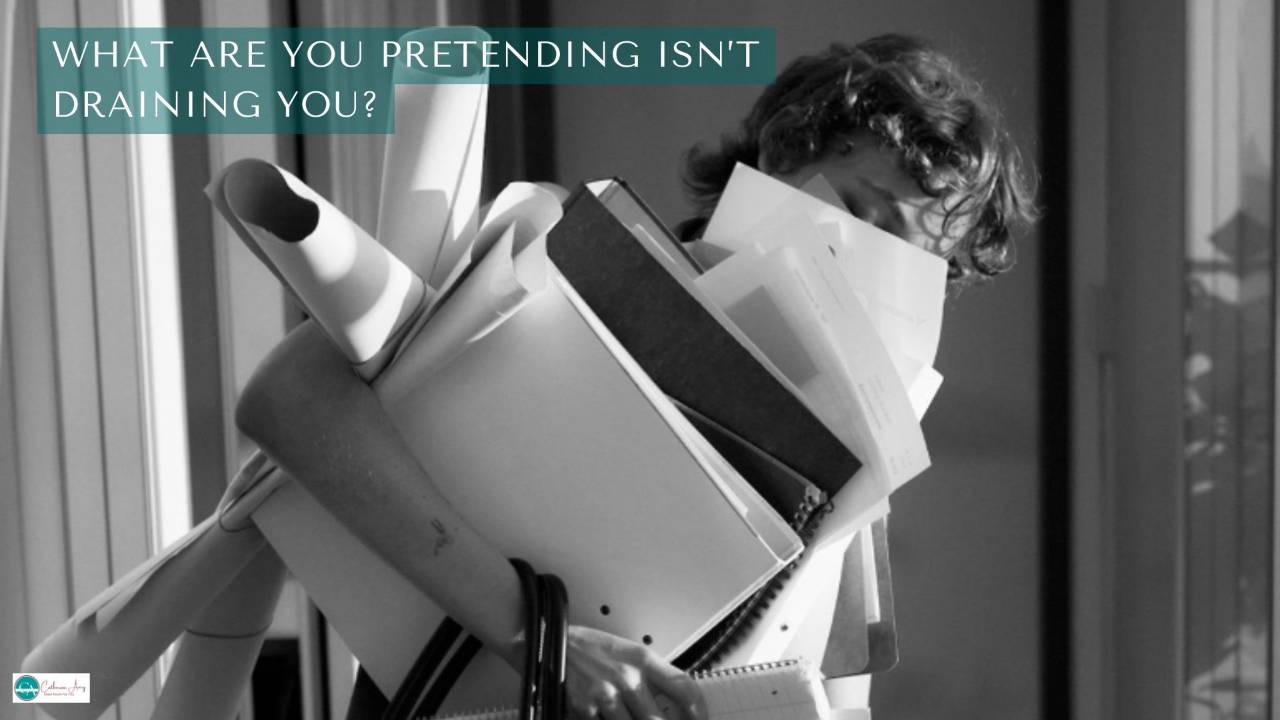
What am I calling “fine” that is quietly draining me?
You do not have to fix everything today.
Just notice one thing.
-
One role.
-
One commitment.
-
One expectation.
-
One system.
-
One mask.
And ask:
Does this still fit the life I am living now?
If the answer is no, maybe that is where you start.
Keep making room for what matters.